Genetics plays a role in Alzheimer’s risk—but for the vast majority of people, it isn’t destiny. Here’s what the research actually says, and the other factors that matter just as much.





If Alzheimer’s disease runs in your family, you’ve probably asked yourself a difficult question at some point:
“Am I next?”
It’s a fear shared by millions of people.
Maybe you watched a parent struggle with memory loss. Perhaps a grandparent was diagnosed later in life. Or maybe you’ve simply noticed yourself forgetting names or misplacing your keys a little more often and wondered whether your genetics have already determined your future.
It’s an understandable concern.
For decades, many people have viewed Alzheimer’s disease as something that is largely inherited — as though a family history automatically means a diagnosis is inevitable.
But the research tells a more nuanced — and ultimately more hopeful — story.
Ask someone what causes Alzheimer’s disease, and chances are, genetics will be near the top of the list.
While genes certainly play a role, the type of genetic risk most people imagine is actually quite rare.
Only about 1% of Alzheimer’s cases are caused by a single inherited gene mutation that essentially guarantees the disease. These rare forms are known as familial, early-onset Alzheimer’s disease, and they affect a very small percentage of the population.
That means for the overwhelming majority of people, genetics tells a very different story. Instead of determining your future, your genes may simply influence your level of risk. And risk is not the same thing as destiny.
That’s an important distinction — because it changes the conversation from one of resignation to one of possibility.
Imagine two people who both carry a higher genetic risk for heart disease. One exercises regularly, maintains a healthy weight, doesn’t smoke and works closely with their physician. The other has very different lifestyle habits and health circumstances.
Would we expect those two people to have identical outcomes? Probably not.
The same principle applies to many chronic diseases, including Alzheimer’s.
Certain genes — most notably APOE-e4 — have been associated with an increased risk of developing late-onset Alzheimer’s disease. But carrying one of these genes doesn’t mean someone will inevitably develop the condition, just as lacking the gene doesn’t guarantee they won’t.
That’s why researchers increasingly distinguish between risk factors and deterministic causes. One raises the odds. The other determines the outcome.
For nearly everyone, Alzheimer’s falls into the first category — not the second.
If genetics isn’t the entire story, what is? That’s one of the most active areas of Alzheimer’s research today.
Scientists continue to study how a wide range of factors may contribute to long-term brain health, including:
Rather than searching for a single cause, researchers increasingly view Alzheimer’s disease as a complex condition influenced by multiple interacting factors.
This doesn’t mean scientists have all the answers. Far from it. But it does mean the conversation has expanded beyond genetics alone.
For many families, hearing “it’s genetic” can feel like the end of the story. But for most people, it may actually be the beginning of a different conversation.
If your genes aren’t writing your future on their own, then understanding the other factors that influence long-term health becomes even more important. That’s an empowering shift.
Instead of asking: “Am I doomed because of my family history?” — you can begin asking:
Those questions are far more productive — and they’re the questions many physicians are increasingly encouraging patients to ask.
One of the most encouraging developments in modern healthcare is that people are becoming more proactive. They’re no longer waiting until symptoms become severe before seeking information.
They’re learning. Asking questions. Looking beyond assumptions. And partnering with healthcare professionals to better understand their overall health.
That doesn’t eliminate uncertainty. But it does replace fear with knowledge. And knowledge creates options.
Alzheimer’s disease is one of the most complex conditions in medicine. Reducing it to a single explanation — whether genetics, lifestyle or any one factor — doesn’t reflect what researchers continue to discover.
For most people, the more useful question isn’t: “Is it genetic?” It’s: “What factors may be influencing my health, and what should I understand about them?”
That’s a much more hopeful place to begin. It’s also where meaningful conversations with knowledgeable healthcare professionals can make the greatest difference.
Some people wait to speak to their healthcare professionals after experiencing years of decline. Even then, they faced twenty doctors who couldn’t help.
Others go in early — proactive, research-oriented and unwilling to wait until the problem gets worse.
What they share is this: they’ve stopped accepting vague answers. They know that even if it’s not in their genes, the toxin burden, inflammatory load and environmental exposure are measurable conditions — and they want an intervention that takes that seriously.
The answer? Therapeutic Plasma Exchange (TPE).
TPE is an established medical procedure that has been used in hospitals for decades. During treatment, a specialized system separates and removes a portion of the plasma — the liquid component of your blood — and replaces it with an appropriate replacement fluid under physician supervision. Plasma naturally carries many circulating substances throughout the body, including proteins, antibodies, immune factors, and other components.
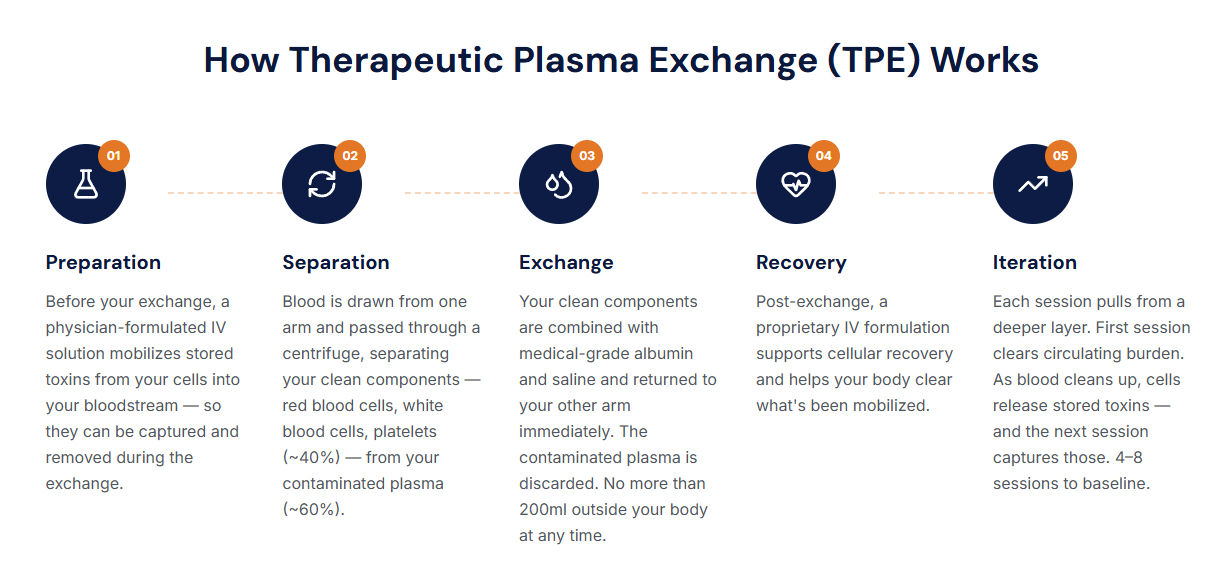
It’s important to remember that TPE is not a cure, a miracle treatment or the right choice for everyone. Whether it may be appropriate depends on your individual health history, goals and a thorough medical evaluation. That is why education and physician guidance come first.
It’s not just about your genes. It’s about inflammation, environmental exposures and proactive brain and whole-body health.
The next step isn’t guessing — it’s getting personalized guidance.
Schedule a free TPE Review to speak with our clinical team. We’ll discuss your health concerns, answer your questions, and help you understand whether Therapeutic Plasma Exchange (TPE) may be appropriate for your individual goals.
No pressure. No obligation. Just an informed conversation.
👉 Schedule your free TPE Review here.
Educational content only; not medical advice. Please consult a qualified healthcare professional about personal medical concerns.